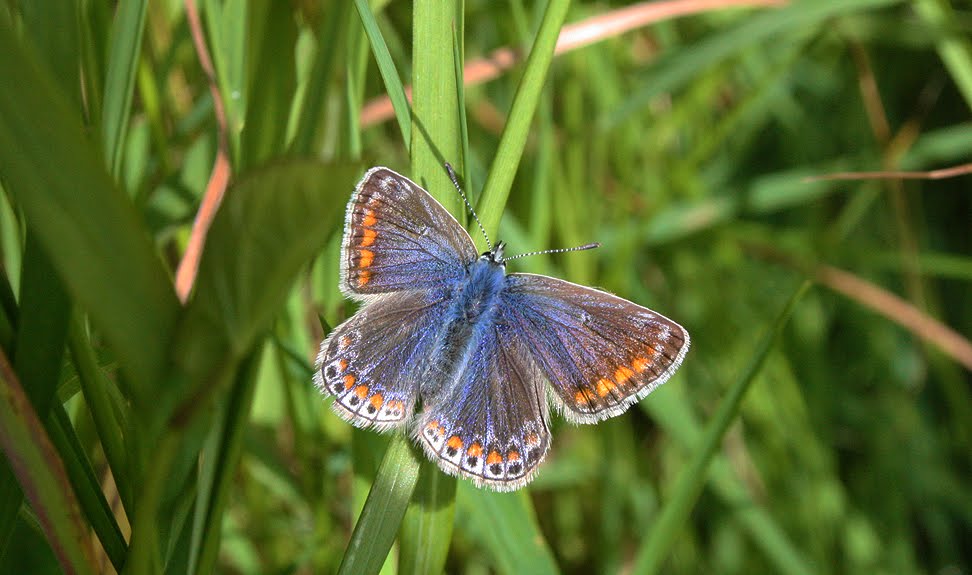
This is to my mind the most fascinating family of butterflies to occur in Ireland. With over 5,000 species worldwide, 75% of them have some kind of relationship with ants. Common blue larvae and pupae for instance, whilst not wholly dependant on ants, are on occasion picked up and treated as part of ant hives. This affords them things like protection. I’m not sure if Irish members of the species have been found to do this though. The other thing that draws me to this family is the tiny size, bold colours and the distinctive face. Nearly all members of the family have black eyes ringed by white hairs. I’m not too pleased with my progress in this family. I have seen plenty of holly blues in Fota and in Cork city but haven’t to my dismay been able to find any at eye level, or even within reach of my 300mm lens. Indeed this species prefers staying up high on holly and ivy plants. Similarly brown and purple hairstreaks are rarely even seen, never mind photographed due to their tree canopy habitats. As for small blue, the money simply hasn’t been there to seek out this tiny and rare species. I hope to change that for 2014.
Common blue (Polyommatus icarus)
The common blue as its name suggests is by far the most common Irish representative of the family. The male is a brilliant blue colour with an attractive white&black fringing to its wings. The female comes in a range of colours from brown to purple to blue but has added orange panels on the upper wings. Both genders have orange panels on their underwings which set them apart from small and holly blues. It seems to have been a great year for them in Co.Cork as I have seen many (an understatement) in Mizen head, Rosscarbery, Lee fields, Atlantic pond area, Carrigaline, Fota island, Great island, Littleisland, Monkstown, Rostellan & Midleton.


Green hairstreak (Callophrys rubi)
A first for me this year seen in Brow head. The green hairstreak seems to be the only remotely approachable hairstreak in Ireland. That’s fine though as it’s also the most attractive with its bright green colours. Seen on one of my favourite days this summer. I am hoping to get some shots with the dotted wing pattern next year.


Small copper (Lycaena phlaeas)
The small copper is interesting in that I missed it entirely last year, and the year before that I only saw one in Ballycotton. I assumed therefore that this was a relatively scarce species overall. To my delight I was wrong. I have now found it in Lee fields, Tullamore, Ballycotton, Carrigaline, Minane & Rosscarbery. It’s an unusual species in that it is sometimes flighty and sometimes approachable. It is the only member of the copper family found in Ireland and can be easily told apart from other butterflies by its tiny size, bright copper panels on the wings and attractive greyish orange underwings.


PIERIDAE (Whites & brimstones)
This family usually referred to as whites has eight Irish species. With the exception of the brimstone and clouded yellow they are all white in colour and generally look quite similar. Because it was the focus of a previous blog post I have excluded the orange tip butterfly from this post.
Brimstone (Gonepteryx rhamni)
I only found this species last week in Tullamore, Offaly. It is probably the most unusual looking white in Ireland with its leaf like shape and greenish colour. It’s quite rare in Cork and other southern counties because of its dependence on buckthorn, a plant that only grows in some areas. I was delighted to pick up this species as my only opportunity to find it coincided with a dreary and rain filled day. Indeed I only found one individual. Luckily it was more then willing to be photographed.

Small white (Pieris rapae)
This species should probably be called the regular sized white as its not noticeably smaller then wood whites or green-veined whites. It is closely related to the below two species and can be told apart mainly by the black tips to its wings and the underwing. The black tips are relatively small and don’t extend down the wings edges (they do in large white), and the underwings are a light yellowish colour and don’t have dark veins (they do in green-veined white). All three species are quite common and have been seen in nearly every place I have been this summer. This species should probably be called the regular sized white as its not noticeably smaller then wood whites or green-veined whites. It is closely related to the below two species and can be told apart mainly by the black tips to its wings and the underwing. The black tips are relatively small and don’t extend down the wings edges (they do in large white), and the underwings are a light yellowish colour and don’t have dark veins (they do in green-veined white). All three species are quite common and have been seen in nearly every place I have been this summer.


Green-veined white (Pieris napi)
Probrably the most common of the three Pieris butterflies.


Large white (Pieris brassicae)
Noticeably bigger then the other Pieris butterflies. More extensive black wing tips help with identification also.


The list so far
Holly blue (seen but not photographed)
Common blue (seen)
Small blue (not seen)
Brown hairstreak (burren only species, not seen)
Purple hairstreak (not seen)
Green hairstreak (seen)
Small copper (seen)
Green-veined white (seen)
Large white (seen)
Small white (seen)
Orange tip (seen)
Brimstone (seen)
Clouded yellow (not seen)
Cryptic wood white (possibly seen, unconfirmed)
Wood white (Burren only species, not seen)