Showing posts with label painted lady. Show all posts

Monday, September 2, 2013

Butterflies - Fritillaries & Nymphalinis

Nymphalini and fritillary butterflies are colourful members of the nymphalid butterfly family. These butterflies are arguably our most colourful and are certainly our most well known. It would be hard to find someone who has never seen a peacock butterfly or a small tortoiseshell.

Marsh fritillary (Euphydras aurinia) 
My first ‘first timer’ species of 2013. Marsh fritillaries are quite rare and are (partially at least) protected in Ireland. This stunning butterfly is worth seeking out. The wing patterns are quite interesting. Unfortunately I found it hard to get an underwing shot and most of my shots where interrupted by tufts of grass partially obscuring the butterflies.

Silver-washed fritillary (Argynnis paphia) 
Before this summer I was completely unaware of this butterfly. I don’t know if my expertise has increased or if this species had an especially good year but I have seen it in four different locations now. This is Ireland’s largest species of butterfly. It makes quite an impression sailing around the forest. This species prefers areas with trees unlike the closely related dark green fritillary which is generally found in coastal habitats.

Peacock (Inachis io) 
The peacock butterfly is probably Ireland’s best known species. Its large size, bold red colouration and the fact that it hibernates in houses makes it almost impossible to avoid. They are seen for a period in spring before they die off but a second generation later in the summer occurs. These later butterflies can be truly magnificent with their vivid red coloration and bright blue eye spots.

Small tortoiseshell (Aglais urticae) 
Another very common butterfly. This species can also be seen through much of the summer but has a massive population explosion around August. I have seen over twenty individuals on one bush. Interestingly on my travels I have noticed that small tortoiseshells outnumber peacocks in some places whilst in others peacocks are far more regular. In my opinion this species looks its best when the blue dots on the rims of its wings are at their most vibrant.

Red admiral (Vanessa atalanta) 
Red admirals are unusual in that I constantly encounter solo individuals throughout the summer but never manage to get close. Then around August they emerge in their hundreds and become very approachable. Red admirals often stay unphased even when you are mere inches away. This large orange reddish species is a staple of flowering shrubs in July-August and can be seen almost anywhere.

Painted lady (Vanessa cardui) 
This relatively common butterfly eluded me last year which prompted me to search far and wide for them. I found my first individuals in Carrigaline, a week later though; I had seen them in about 5 different sites. It’s a relative of the above red admiral but can be easily told apart by its duller orange coloration. Anywhere the above three species can be seen is worth checking for painted ladies.

The list so far 
Peacock (seen)
Small Tortoiseshell (seen)
Painted Lady (seen)
Red Admiral (seen)
Silver-washed Fritillary (seen)
Dark Green Fritillary (a species I unfortunatly missed this year)
Marsh Fritillary (seen)
Pearl-bordered Fritillary (a burren only species that I hope to find next summer)
Comma (Not found in Cork. Again, I will be seeking it out in 2014)

Wednesday, November 21, 2012

Butterflies, counting up 2012

Tallying up the butterflies of 2012

1. Peacock butterfly (Inachis io)
Its pretty and its common, exactly what you want from a butterfly.


2. Small tortoiseshell (Aglais urticae)
Also quite common, but not always as approachable as you might think


3. Painted lady (Vanessa cardui)
Managed to spot a couple at the very end of the season, they are common outside the city but in the centre are quite hard to find.


4. Red admiral (Vanessa atalanta)
Towards the end of the summer season this butterfly becomes quite common. It is not unusual to find a bush entirely with examples of this species.


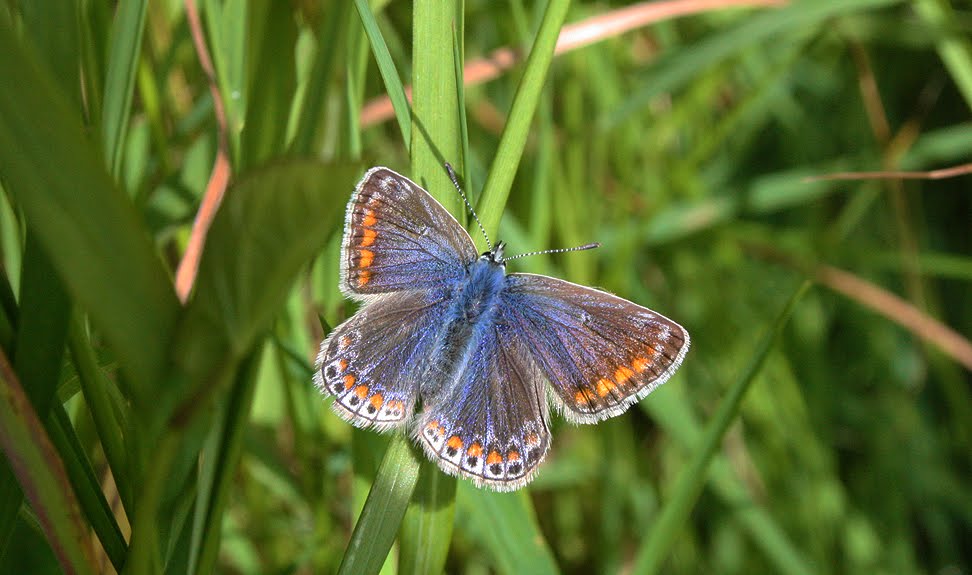
5. Common blue (Polyommatus icarus)
Even those without an interest in insects probably have to admit that the common blue makes a great subject for photography. Its often quite vivid and is relatively approachable. Not to mention that unlike most Irish butterflies its underwing has quite interesting patterns.


6. Speckled wood (Pararge aegeria)
A constant companion on my summer time walks. The speckled wood is probably more interesting behaviourally then visually as it’s quite territorial and aggressively defends its patch from other butterflies. It has also ruined my attempts to photograph nearby species on occasion by scaring them off!


7. Meadow brown (Maniola jurtina)
A well camouflaged butterfly often found sitting with its wings closed and enjoying the camouflage that its brown colouration affords it. With wings open it is actually quite nice to look at, I like those false eyes with the yellowish surroundings.


8. Ringlet (Aphantopus hyperantus)
I admit I am cheating here; this shot is from last year. This years shots where lost due to camera theft and the only surviving picture is buried somewhere in a facebook page where I can’t find it. I swear, I had pictures!


9. Green veined white (Pieris napi)
Ireland’s most common white butterfly. The green veined is easy enough to identify due to its underwing being patterned with green veins (yes). The other species don’t have this.


10. Small white (Pieris rapae)
Can be hard to tell apart from the large white except that its size is closer to that of the other whites.


11. Large white (Pieris brassicae)
Like the above species but much larger and with a different pattern of black on its wings, in the field its quite easy to tell the size difference.


12. Cryptic wood white (Leptidea juvernica)
Only recently named species, the cryptic wood white is small, has rounded wings and has weak flight. The common wood white is almost identical but is quite hard to find in Ireland. Outside the Burren and select area the cryptic is the primary wood white species.


13. Orange tip (Anthocharis cardamines)
Easy to identify with the males having bright orange tips to their wings and both genders having a distinct green marbling on its underwing. Its flight season is quite short and 2012 was the first year where I managed to catch it on camera.


Species I would like in 2012. Holly blue. Small blue, all the frits, green hairstreak and a couple of others.